What kind of media setup are you planning?
No votes yet. Yours will be the first. · saved on this device
Loading...
Home Control Notes · Service guide
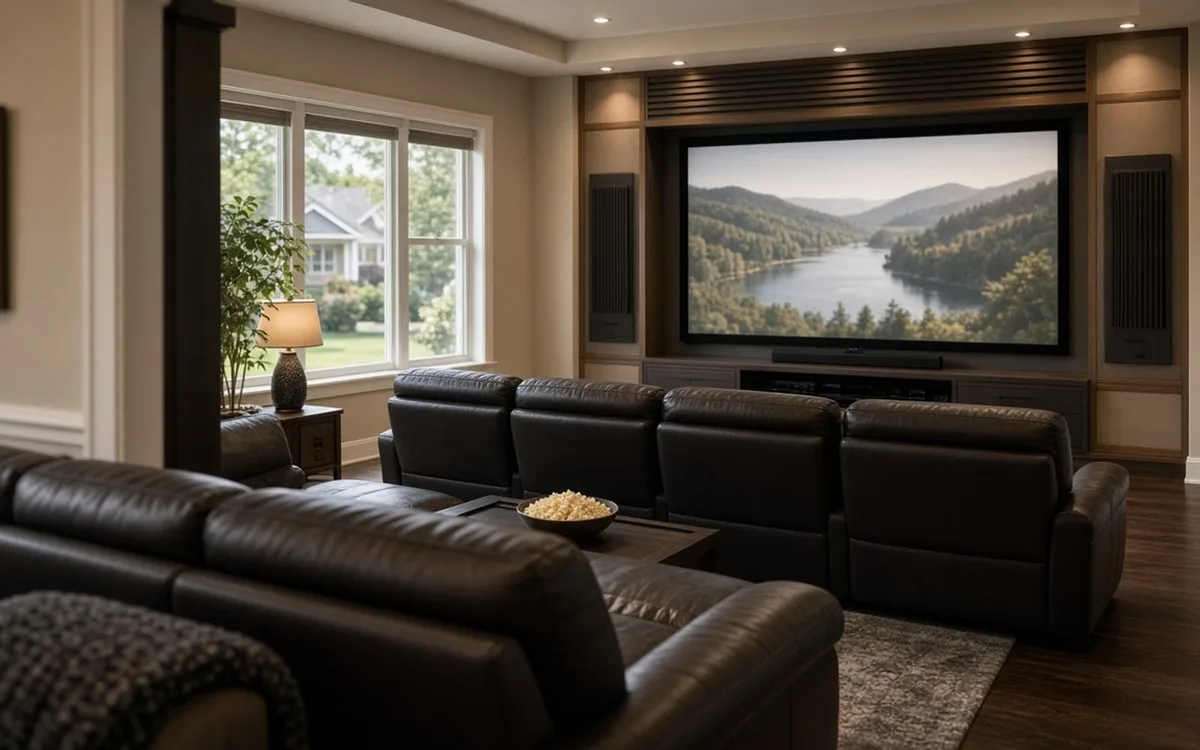
Home theater and audio installation covers dedicated theaters, living-room media setups and multi-room audio, including speakers, displays, receivers, cabling, equipment placement and the controls the household uses daily. It suits listeners who know their rooms and seating. Costs run from about $2,000 for a basic installed 5.1 system to $25,000 or more for a custom dedicated theater, with a well-equipped living room at $2,000 to $4,000.
One in four U.S. homes already has a theater or audio system according to the EIA's 2024 survey, which found 25.0% of occupied primary residences with one. Most of those are receiver-and-speaker setups gathered over time, with a remote nobody else understands. The point of a planned installation is a system that fits the room, stays cool, and can be operated by a visitor.
Audio work rewards timing. In-wall speaker cable, a conduit to the display and a rack location with ventilation cost little when walls are open and a great deal afterward, and the equipment is only part of it: Today's Homeowner puts an integrated home entertainment subsystem at $2,000–$4,000. This page covers room and seating, equipment choices, cabling, cooling, controls and documentation, with 2026 price ranges and the questions that separate a durable system from an expensive tangle. Matched local installers provide free written estimates.
Want the numbers only? Read the home theater & audio cost guide for 2026 ranges, what moves the price, and sample budgets.
| Item | Low | High | Unit | Notes |
|---|---|---|---|---|
| Display or projector and screen | $800 | $8,000 | flat | Projector packages at the top |
| AV receiver or amplifier | $400 | $3,000 | flat | |
| In-wall or in-ceiling speakers, installed | $150 | $600 | per speaker | Includes cable run |
| Multi-room audio zone | $500 | $1,500 | per zone | |
| Equipment rack with cooling | $300 | $1,500 | flat | |
| Universal control or keypad, programmed | $200 | $1,000 | flat | |
| Basic 5.1 system, installed | $2,092 | $3,237 | flat | Homewyse, September 2026 |
| Living-room entertainment system | $2,000 | $4,000 | flat | Today's Homeowner, January 2023 prices |
| Custom dedicated theater room | $25,000 | $60,000 | flat | AWOL Vision 2026; luxury rooms $60,000–$100,000+ |
A dedicated theater is a room built for one purpose: controlled light, fixed seating, a projector or large display, and surround speakers placed by geometry rather than furniture. A living-room setup shares the space and compromises on both, usually with a large display, a soundbar or compact surround system, and hidden cabling. Multi-room audio distributes music to kitchens, patios and bedrooms through in-ceiling speakers or networked streaming speakers.
Most households want the second and third, not the first. The EIA found an internet streaming device in 66.5% of homes and smart-speaker TV control in 8.4%, which describes a living room built around streaming rather than discs. Decide which of the three you are buying before an installer proposes a package, and read the dedicated theater versus living-room comparison for the trade-offs.
Speaker positions, display size and projector throw all follow from where people sit. A living room with a sofa nine feet from the wall supports a 65- to 85-inch display; a dedicated theater with two rows needs a riser for the second row and a screen sized for the front row's viewing angle. Ambient light decides projector versus display: a room with windows and no blackout blinds is a display room regardless of what the brochure shows.
Ask the installer for a scaled sketch showing seating, display, speaker positions and the equipment location before any equipment is priced. That drawing is the specification. Note doors, HVAC vents and windows, because a subwoofer near a door and a speaker beside a vent both cause complaints later. If the room will also host a lighting scene, coordinate with the lighting plan now.
Today's Homeowner places an integrated home entertainment subsystem at $2,000–$4,000, alongside security at $500 to $5,000 and HVAC automation at $1,000 to $3,000. That covers a living-room setup with a display, a receiver or soundbar system, hidden cabling and a universal control. A multi-room audio system runs roughly $500 to $1,500 per zone installed depending on speaker grade and whether the amplifier is centralized or built into each speaker.
A dedicated theater is a different budget. Projector, screen, seven or more speakers, seating, acoustic treatment, blackout, a rack and a dedicated circuit put a custom room at $25,000–$60,000+ in AWOL Vision's 2026 guide, and a professional media room in an existing space at $10,000 to $30,000. That gap, not a disagreement between sources, is why the figures quoted for "home theater cost" range from a few thousand dollars to tens of thousands: they describe different projects. Labor is a modest share of a theater; equipment and construction dominate. The calculator counts each speaker zone, display and source as a control point.
| Scope | Range | Source | Main driver |
|---|---|---|---|
| Soundbar and display upgrade with hidden cabling | $800–$2,500 | Site estimate | Display size, wall type |
| Basic 5.1 system, installed | $2,092–$3,237 | Homewyse, Sep 2026 | Speaker count, cable runs |
| Living-room surround with receiver | $2,000–$4,000 | Today's Homeowner, Jan 2023 prices | Speaker count, in-wall vs freestanding |
| Multi-room audio, per zone | $500–$1,500 | Site estimate | Speaker grade, amplifier location |
| Professional media room | $10,000–$30,000 | AWOL Vision 2026 | Projector, screen, in-wall work |
| Custom dedicated theater | $25,000–$60,000+ | AWOL Vision 2026 | Construction, seating, acoustics |
Cabling outlives equipment. Run speaker cable to every planned position, at least two network drops to the display and rack locations, and an empty conduit from the rack to the display so a future HDMI standard can be pulled without opening drywall. HDMI over long runs is the most common failure in retrofits; fiber or active cables solve it but cost more, and the conduit makes the fix trivial.
Equipment should be named in the proposal by model number: display or projector and screen, receiver or amplifier, each speaker, the streaming source, the control system and the rack. Named equipment prevents substitution and lets you compare bids. Ask which components are dealer-only and which you could replace yourself later, because a system built entirely on dealer-only parts is harder to maintain if the relationship ends.
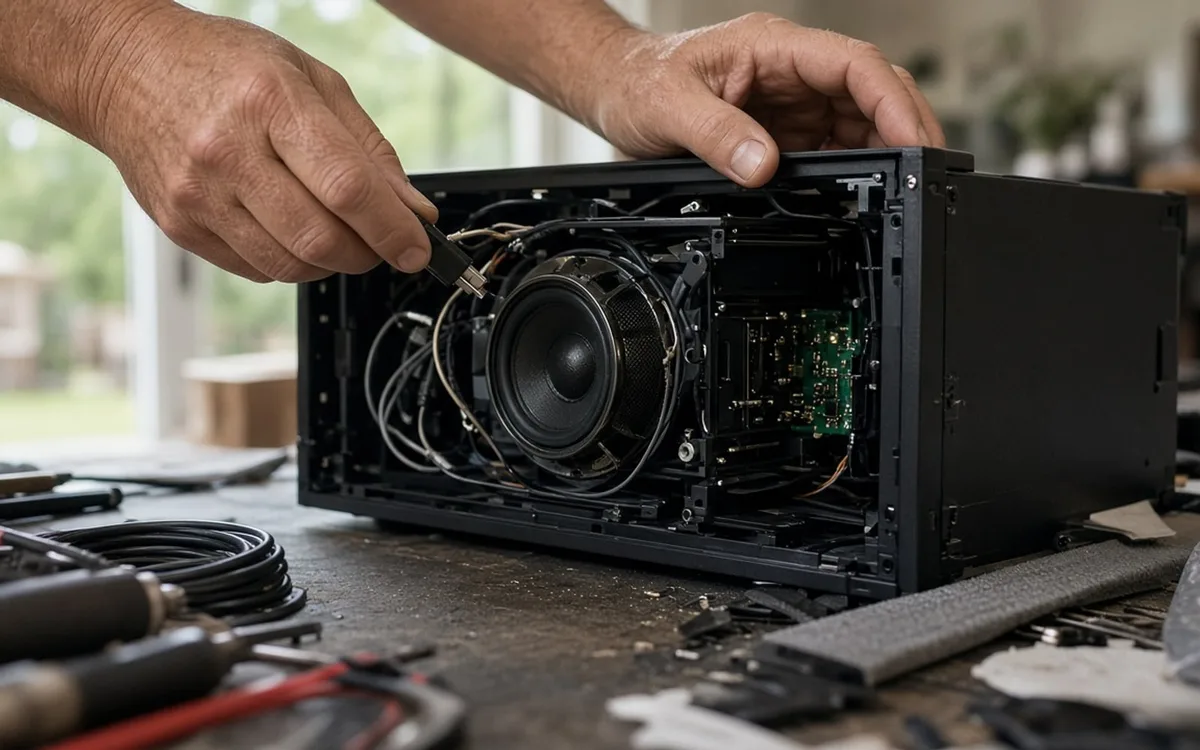
Receivers, amplifiers and projectors generate heat, and an enclosed cabinet without airflow shortens their life and causes shutdowns mid-movie. Plan a rack in a closet with an intake at the bottom and an exhaust fan at the top, or an open shelf. Projectors need clearance around their vents and a mount that does not trap warm air at the ceiling. A pro should state the cooling plan in the proposal, and a thermostat-controlled fan is a small line item that prevents a large one.

The system fails if only one person can turn it on. A single remote or wall keypad with 'Watch TV', 'Watch a movie' and 'Play music' buttons is the target. Voice is a convenience layer, not the plan; our analysis of the EIA's 2024 survey found only 8.4% of homes use a smart speaker for TV control. Every source should be selectable without knowing which HDMI input it uses, and the display should turn on with the receiver. Test this with a guest before final payment.
Documentation should include the equipment list with serial numbers, the wiring diagram with every cable labeled at both ends, the control programming file, network details and the account list, all in your name. Deloitte found 77% of adopters say devices improve quality of life, but the 20% who report frustration are often living with an undocumented system. The whole-home page explains how audio ties into scenes.
Bare rooms with hard floors echo; a rug, curtains and a few absorptive panels fix most living rooms without a full treatment. Basements in the Midwest and Northeast, where the EIA found audio-system ownership of 26.7% and 21.6% respectively, add moisture concerns: keep the rack off concrete, add a dehumidifier and check for radon before finishing. In the West, where ownership is highest at 28.7%, outdoor zones and heat-rated speakers are common. See the locations page.
Mistakes to avoid: a projector in a room with daylight, a subwoofer chosen before the room is measured, a display mounted above a fireplace where heat and neck angle both suffer, and a cabinet with no ventilation. Each is common because it looks fine on the drawing. Ask the installer to explain why each position was chosen, and to note in writing any compromise you insisted on.
Line up the equipment lists by model number, the cabling and conduit plan, the rack and cooling plan, the control approach and the documentation promised. Compare what happens when a streaming service or the dealer platform is unavailable: is there a source that plays without a login? Then ask each bidder what they left out of the price, such as seating, blackout, painting and electrical, and whether their programming can be handed to another installer. The polls show what other homeowners prioritized.
Homeowner polls
No votes yet. Yours will be the first. · saved on this device
No votes yet. Yours will be the first. · saved on this device
 Service guideWhole-Home Automation
Whole-home automation connects lighting, climate, locks, cameras, shades and audio under one interface with scenes and schedules.
 Service guideSmart Lighting Control
Smart lighting control replaces switches and dimmers, or adds keypads and schedules, so rooms respond to scenes, timers and occupancy while the wall switch keeps working.
A display, in almost every living room. Projectors need controlled light, a screen, ceiling mounting and lamp or laser maintenance, and they lose contrast the moment a window is uncovered. Displays now reach 85 to 100 inches at prices that compete with a projector and screen, and they work at noon. Reserve projectors for dedicated rooms with blackout and fixed seating, where the larger image justifies the constraints.
For multi-room music and height channels, yes. For the front three channels of a theater, freestanding or in-wall speakers at ear height produce a clearer image than ceiling speakers aimed downward. A common compromise is in-wall front speakers, in-ceiling surrounds and heights, and a freestanding subwoofer. Ask the installer to explain speaker placement in terms of the seating plan rather than the wall that was convenient.
Often, as zones within a larger system. Networked speakers from one maker group together in their own app, and many integrate with control platforms so a keypad can start music. The limits are sound quality in larger rooms and dependence on that maker's cloud for grouping. A hybrid plan puts amplified in-ceiling speakers in main rooms and streaming speakers in bedrooms and offices, all selectable from one control.
In a living room, a rug, curtains and two to four absorptive panels at first-reflection points cost a few hundred dollars and fix most echo. A dedicated theater might spend $1,500 to $6,000 on panels, bass traps and fabric walls. Treatment is cheaper than upgrading speakers to fight a bad room, so ask the installer whether the room or the equipment is the constraint before buying more hardware.
One control with activity buttons such as 'Watch TV' and 'Play music' that turns on the right devices and selects inputs automatically. That can be a programmed handheld remote, a wall keypad, an app, or all three. Voice can start music but is a poor primary control for a theater. Ask for a demonstration by someone who did not program it, and make sure a guest could start a movie without instructions.
A dedicated theater appeals to a narrow set of buyers and rarely returns its full cost; a well-wired living room with hidden cabling, in-ceiling speakers and a documented system appeals broadly and shows well. If resale matters, spend on infrastructure that any buyer can use and keep dedicated-theater construction reversible. The EIA found a theater or audio system in a quarter of homes, so buyers do expect wiring but not necessarily a projector.
In a closet or rack location with ventilation if cabling permits, because it keeps heat, noise and clutter out of the room and allows a clean display wall. Infrared remotes then need a repeater or a network-based control. In the room, an open, ventilated cabinet is acceptable; a closed cabinet without airflow is the most common cause of overheating shutdowns. Either way, plan a dedicated circuit and a network drop at the rack.
A living-room setup with hidden cabling takes one to two days once walls are open or fishable. Multi-room audio across five zones takes two to four days for cabling and a day for programming. A dedicated theater is a construction project measured in weeks, with framing, electrical, drywall, paint, seating and equipment in sequence. Ask for a schedule that separates rough-in from trim-out so other trades can be coordinated.
 Free toolSmart home cost calculator: size a budget by control points
Size, material tier and complexity in, a realistic budget range out.
 Free toolSmart home comparisons: the five decisions that shape the project
Side-by-side tables for the decisions that change the price most.
 Free toolSmart home readiness quiz: do you know the details installers will ask about?
10 questions that show what you already know and what to check next.
 Free toolSmart home polls: how other homeowners weighed the same decisions
See what other planners chose and add your vote.
Tell us the size, the condition of what is there now, and what you want to change. Home Control Notes passes your request to independent local professionals, who reply with written, no-obligation estimates. The service is free to use.