What kind of media setup are you planning?
No votes yet. Yours will be the first. · saved on this device
Loading...
Home Control Notes · Home Theater & Audio cost guide
A basic installed 5.1 home theater costs $2,092 to $3,237 according to Homewyse's September 2026 figures, and a fully equipped living room runs $2,000 to $4,000. A custom dedicated theater is a construction project at $25,000 to $60,000 or more, per AWOL Vision. Multi-room audio adds cost per zone, and cable paths explain most differences between quotes.
Theater and audio budgets split into two very different kinds of spending. Equipment, the display, speakers, receiver and streamers, is easy to price and gets replaced every several years. Infrastructure, the cable paths, in-wall speakers, equipment location, ventilation and, in dedicated rooms, the construction itself, is harder to price and lasts for decades. Good budgets spend deliberately on infrastructure and leave room to upgrade equipment.
This page covers cost only: per-zone and per-room ranges, tiers, add-ons, the labor share, timing, what to cut first and sample budgets. The cost table and calculator on this page carry the line items; the sections below show how they combine for a living room, a multi-room system and a dedicated theater.
| Item | Low | High | Unit | Notes |
|---|---|---|---|---|
| Display or projector and screen | $800 | $8,000 | flat | Projector packages at the top |
| AV receiver or amplifier | $400 | $3,000 | flat | |
| In-wall or in-ceiling speakers, installed | $150 | $600 | per speaker | Includes cable run |
| Multi-room audio zone | $500 | $1,500 | per zone | |
| Equipment rack with cooling | $300 | $1,500 | flat | |
| Universal control or keypad, programmed | $200 | $1,000 | flat | |
| Basic 5.1 system, installed | $2,092 | $3,237 | flat | Homewyse, September 2026 |
| Living-room entertainment system | $2,000 | $4,000 | flat | Today's Homeowner, January 2023 prices |
| Custom dedicated theater room | $25,000 | $60,000 | flat | AWOL Vision 2026; luxury rooms $60,000–$100,000+ |
The floor for a professionally installed system is Homewyse's September 2026 price for a basic 5.1 package, $2,092–$3,237, which covers five speakers, a subwoofer, one display and one receiver with the cabling between them. A fuller living-room system, with a display or short-throw projector, in-ceiling speakers, hidden cabling and one remote, sits in the range Today's Homeowner gives for a fully equipped living room: $2,000–$4,000 at January 2023 prices. Multi-room audio adds cost per zone, each zone being a room or area with its own volume and source, whether it runs on in-ceiling speakers and an amplifier or on networked speakers.
A dedicated theater is a different kind of project. It adds framing, drywall, sound isolation, acoustic treatment, ventilation, seating, lighting and electrical work to the audio-video scope, and the construction trades usually cost more than the equipment. AWOL Vision, a projector maker, puts a custom dedicated theater at $25,000–$60,000+; the tiers in the table in this section show how far apart the scopes sit. When one site quotes a few thousand dollars for a home theater and another quotes tens of thousands, they are usually describing a living room and a purpose-built room. The theater versus living-room comparison weighs whether the premium suits your household.
| Scope | Installed cost | Source |
|---|---|---|
| Basic 5.1 system, professionally installed | $2,092–$3,237 | Homewyse, Sep 2026 |
| Fully equipped living room | $2,000–$4,000 | Today's Homeowner, Jan 2023 prices |
| Professional media room | $10,000–$30,000 | AWOL Vision 2026 |
| Custom dedicated theater | $25,000–$60,000+ | AWOL Vision 2026 |
| Luxury reference-grade cinema room | $60,000–$100,000+ | AWOL Vision 2026 |
At the entry tier, a soundbar with a wireless subwoofer and a streaming device on the display delivers good sound with almost no installation. The middle tier adds a receiver, in-ceiling or in-wall speakers for surround, a separate subwoofer, concealed cabling and programmed control. The top tier adds separate amplification, a projector and screen, calibration, acoustic treatment and a rack with cooling. Each tier roughly adds a new category of labor rather than only more expensive equipment.
Streaming has shifted the budget toward speakers and away from sources. Our analysis of the Energy Information Administration's 2024 survey found 66.5% of homes have a streaming device, so most systems no longer need disc players or many inputs. That frees budget for better speakers, a subwoofer placed well and calibration, which do more for sound quality than an expensive receiver feeding poor speakers.
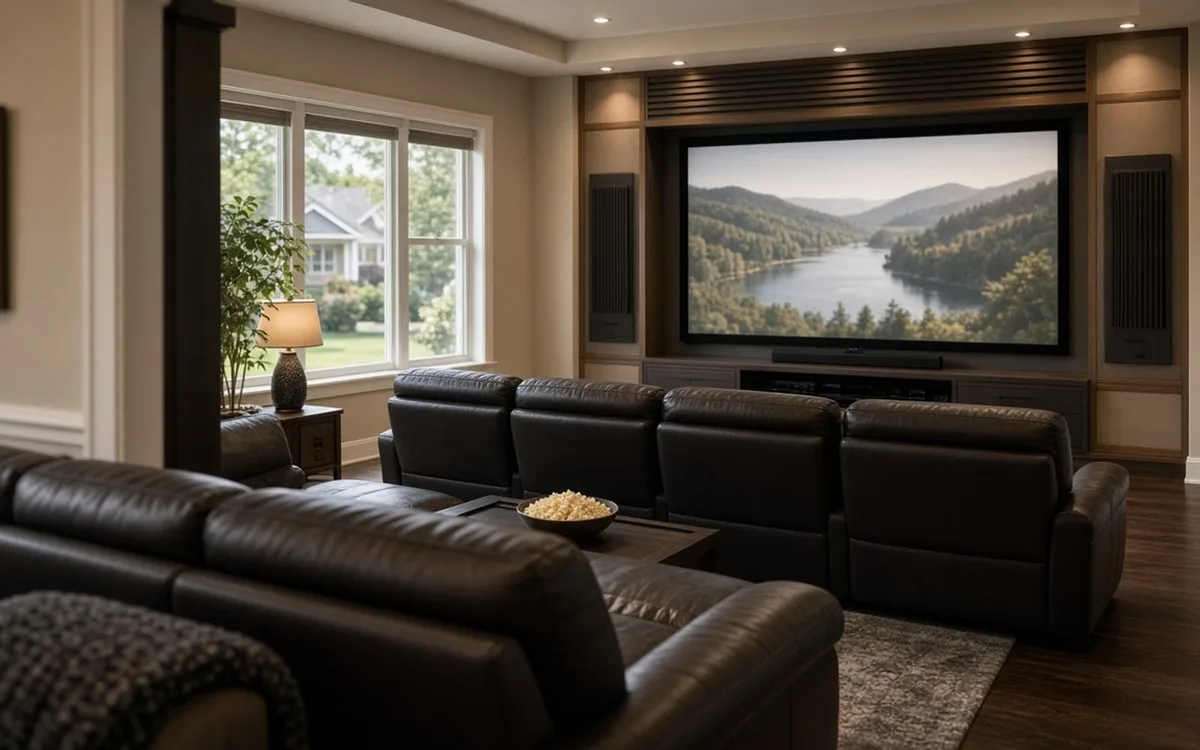
Conduit to the display location is a modest add-on that saves a great deal later, because display formats and cables change and conduit allows new pulls without opening walls. An equipment rack or closet with ventilation, a dedicated circuit and a network connection is the next significant add-on. Universal control programming, so one remote or keypad runs everything, is often the add-on that decides whether the family uses the system.
Further add-ons include acoustic panels, blackout shades, lighting scenes tied to playback, outdoor audio zones and calibration of speakers and picture. Outdoor audio in particular needs weather-rated speakers and amplifier capacity. By our analysis of EIA data, 28.7% of Western homes have a theater or audio system against 25.0% nationally, partly reflecting year-round outdoor living. Price each add-on separately so you can move it between phases, and check the lighting cost guide if scenes are part of the plan.
AWOL Vision puts theater installation labor anywhere from $100 to more than $2,000, depending on ceiling mounts, in-wall wiring, new circuits and speaker work; Today's Homeowner's hourly figure, at January 2023 prices, is $80–$100/hr. On a soundbar installation labor is small; on a system with in-ceiling speakers, concealed cabling, a display mount on masonry and a rack, it becomes the largest line. Cable paths drive it: a first-floor room above an unfinished basement is quick, a second-floor room with no attic access is slow, and plaster or brick adds time at every opening.
Programming and calibration are labor too. Setting speaker levels and distances, room correction, display settings and a control system that powers everything on with one press can take hours. Ask bidders to itemize mounting and wiring, programming and calibration separately, and ask what calibration they perform. Deloitte found 77% of adopters say their devices improve daily life, and a well-programmed remote is much of that.
Speaker wire, conduit and network drops are cheapest before drywall, so any remodel, basement finish or new build is the moment to wire for audio even if speakers come later. Pre-wiring a few zones and the display location costs little compared with retrofitting, and demand grows room by room: EIA found 18.5% of occupied U.S. homes already have two or more smart speakers. A dedicated theater follows a construction schedule with inspections, so its cost is sensitive to trade availability and material prices.
Equipment timing matters differently. Displays and receivers follow annual model cycles, and prices on outgoing models often fall when new ones arrive. Installation labor does not follow the same cycle. If the budget is tight, do the wiring and speakers now, buy the display later and let the installer program it on a short return visit.
Cut electronics before infrastructure, and phase rather than abandon; EIA found 66.5% of occupied U.S. homes already have a streaming device that can carry a first phase. A modest receiver can be upgraded later; in-ceiling speaker locations and conduit cannot be added cheaply once ceilings are finished. Reduce the number of audio zones in the first phase, use a soundbar before a full surround system, and defer acoustic treatment until you hear the room. Keep ventilation and the dedicated circuit for any rack, because overheating causes the most service calls.
A starter budget covers a soundbar, subwoofer and concealed display cabling. A mid budget covers a living-room surround system with in-ceiling speakers, a receiver, a universal remote and two audio zones, around the Today's Homeowner range. A full budget is a dedicated theater with construction, projector, treatment and calibration. The theater and audio service page covers planning, and the estimate request page collects matching bids.
By the numbers
Planning figures from published U.S. sources; every card links to where the number came from.
$2,092–$3,237
installed cost of a basic 5.1 home theater system (Homewyse, September 2026)
Homewyse prices a discrete 5.1-channel system with a compact speaker set and 100W subwoofer, including locating and cutting openings for one display and one receiver, installing five speakers and running the cabling between components.
Homewyse, Cost to Install Home Theater System (2026)$25,000–$60,000+
cost of a custom dedicated home theater room (AWOL Vision, 2026)
AWOL Vision's May 2026 guide sets a professional media room installation at $10,000–$30,000, a custom dedicated theater at $25,000–$60,000 or more, and a luxury reference-grade cinema room at $60,000–$100,000 or more. AWOL sells projectors, so treat it as a vendor source.
AWOL Vision, Home Theater Installation Cost (2026)$2,000–$4,000
cost of a fully equipped living room with a home theater system (prices as of January 2023)
Today's Homeowner's cost guide places a living-room entertainment setup among the mid-priced subsystems, alongside security at $500–$5,000 or more and HVAC automation at $1,000–$3,000. Its prices are marked as of January 2023. A dedicated theater room is a separate, much larger project.
Today's Homeowner, How Expensive Are Smart Homes (2023)$80–$100/hr
professional smart home installation labor rate (prices as of January 2023)
Today's Homeowner notes rewiring a whole home typically costs $2,000–$4,000 and can reach $10,000 in larger homes, which is why retrofit projects should be scoped room by room and labor listed separately. Its prices are marked as of January 2023; HomeAdvisor's June 2026 camera-installation labor rate of $50–$100 an hour is a newer cross-check.
Today's Homeowner, How Expensive Are Smart Homes (2023)The calculator uses the same smart home automation benchmarks as this guide. Set the size and tier, then request a written estimate to check it against a real proposal.
Homeowner polls
No votes yet. Yours will be the first. · saved on this device
No votes yet. Yours will be the first. · saved on this device
Angi's 2026 consumer benchmark averages $771; HomeGuide's whole-home tier is $5,000 to $15,000.
No votes yet. Yours will be the first. · saved on this device
It depends on whether the zone uses in-ceiling speakers wired to a central amplifier or a networked streaming speaker. Wired zones add speakers, cable runs, amplifier channels and ceiling cutouts; networked zones add mostly the speaker itself. Wired zones cost more to install and are more reliable. Ask bidders to price one zone and each additional zone separately.
At very large sizes, sometimes, but a projector needs a screen, a mounting location, light control and periodic lamp or light-source attention. In a bright living room, a large display is usually the better value. In a dark dedicated room, a projector often delivers a larger image for the money. Compare total installed cost, not just the device price.
For most mid-range and dedicated systems, yes. Speaker level, distance and room-correction setup changes how the system sounds far more than moving up a receiver tier, and display calibration corrects picture settings shipped for store lighting. Many installers include basic calibration; full calibration with measurement equipment is usually a separate line.
Often. Good passive speakers last decades and can be driven by a new receiver or amplifier. Older receivers may lack current video standards or streaming features, which a separate streamer can sometimes fill. Ask the installer to assess what you own before pricing replacements, and to explain any item they recommend replacing.
They often price different scopes. Differences in construction, acoustic treatment, calibration, control programming and the equipment tier can each swing the total. Put bids side by side by line item. A quote much lower than others may exclude construction or calibration; a much higher one may include premium equipment you did not request.
Programming time depends on the number of devices, rooms and lighting or shade integrations. A single-room system with a display, receiver and streamer is a short job; a multi-room system with lighting scenes and audio zones takes much longer. Ask for the programming as a separate line and for a list of which buttons do what.
Yes. Outdoor speakers must be weather-rated, cable runs through exterior walls and landscape take longer, and larger outdoor spaces often need more amplifier power or more speakers to cover evenly without being loud near the house. Landscape speaker systems with buried cable cost more again. Ask about burial depth and cable rating.
 Whole-Home Automation · Cost guideHow much does whole-home automation cost in 2026?
Whole-home automation in 2026 ranges from Angi's $771 average for a consumer starter system to HomeGuide's $2,000 to $15,000 or more for hub-based and dealer-integrated projects.
 Smart Lighting Control · Cost guideWhat smart lighting control costs, switch by switch and room by room
Today's Homeowner puts fully automated whole-home lighting at $1,000 to $5,000, with electrician labor at $80 to $100 an hour.
 Home Security & Surveillance · Cost guideWhat a home security and surveillance system costs to install and to keep
Professionally installed security cameras average $1,289 in 2026, with most projects between $589 and $2,040, according to HomeAdvisor.
 Service guideHome Theater & Audio
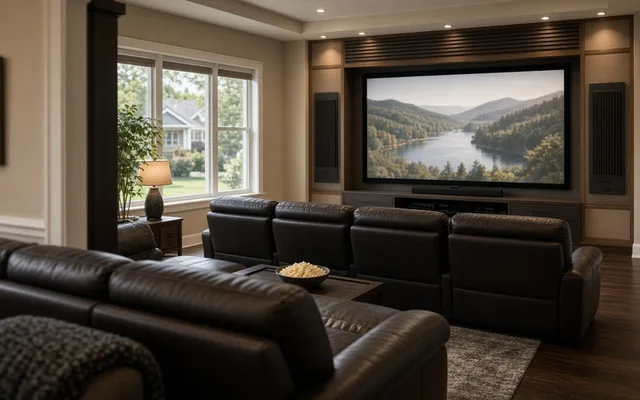
Home theater and audio installation covers dedicated theaters, living-room media setups and multi-room audio, including speakers, displays, receivers, cabling, equipment placement and the controls the household uses daily.
Service guideWhole-Home AutomationWhole-home automation connects lighting, climate, locks, cameras, shades and audio under one interface with scenes and schedules.
Service guideSmart Lighting ControlSmart lighting control replaces switches and dimmers, or adds keypads and schedules, so rooms respond to scenes, timers and occupancy while the wall switch keeps working.
 Free toolSmart home cost calculator: size a budget by control points
Size, material tier and complexity in, a realistic budget range out.
 Free toolSmart home comparisons: the five decisions that shape the project
Side-by-side tables for the decisions that change the price most.
 Free toolSmart home readiness quiz: do you know the details installers will ask about?
10 questions that show what you already know and what to check next.
 Free toolSmart home polls: how other homeowners weighed the same decisions
See what other planners chose and add your vote.
Tell us the size, the condition of what is there now, and what you want to change. Home Control Notes passes your request to independent local professionals, who reply with written, no-obligation estimates. The service is free to use.